 Tasaheel ERP
Year-End Close: Steps, the Closing Entry and Carried Balances
A year-end close guide: year-end adjustments, stocktake, provisions, zakat or tax, closing revenue and expenses to retained earnings, and opening the new year.
 By Sherif Fadl — Founder, Tasaheel ERP
The year-end close is when a full year of activity becomes final financial statements, and the new year starts with correct balances. If the monthly close has been regular all year, the year-end close is much easier. This guide sets out the steps, explains the closing entry, and what happens to balances.
Before closing: year-end adjustments
- Close the last month with all its items: bank reconciliation, depreciation, accruals and prepayments. See month-end close.
- The annual stocktake and adjustment of differences, applying the lower of cost and net realisable value. See stock counts and valuation.
- Provisions: end-of-service, expected credit losses and any other. See provisions.
- Fixed assets: depreciation to the last day, and a review of disposals. See fixed assets and depreciation.
- Agree balances with customers, suppliers, banks and government bodies.
- Zakat or income tax for the year and its entry.
- Review the trial balance and statements before closing, and export them for the auditor.
The closing entry
At year end, revenue and expense accounts are zeroed and their net is carried to retained earnings:
- Debit revenue accounts (their balances)
- Credit expense accounts (their balances)
- The difference (net profit) to retained earnings — or from it, if a loss.
Example: revenue for the year SAR 1,312,500 and expenses SAR 1,158,525, so net profit of SAR 153,975 is carried to retained earnings.
Asset, liability and equity accounts are not closed; their balances carry forward as the opening balances of the new year.
After closing
- Lock the year against changes, so no figure moves after the statements are approved.
- Open the new year with the carried opening balances.
- Keep the closed year's statements for comparison in later years.
How Tasaheel Accounts handles the year-end close
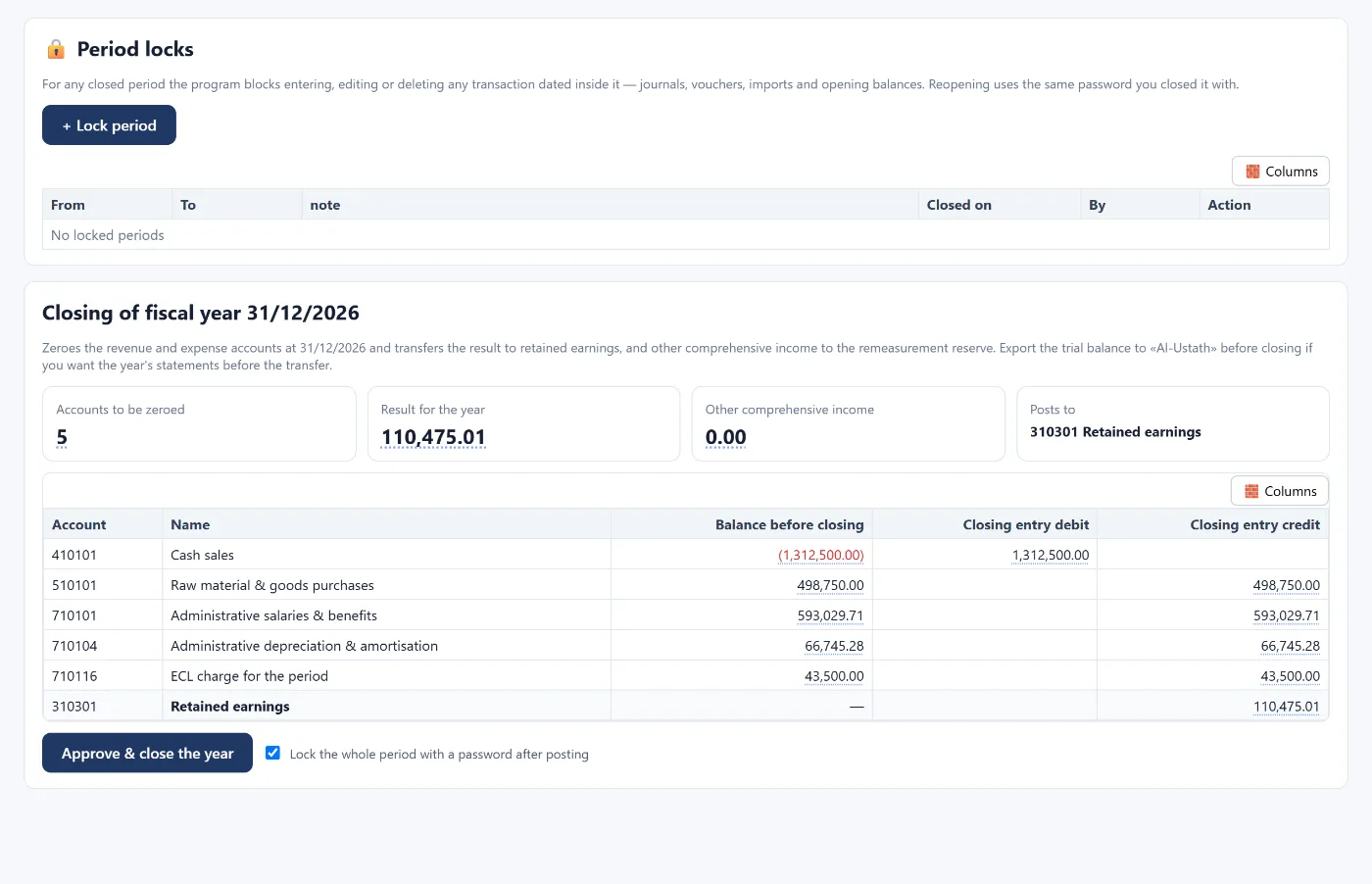
- Period close: in a closed period the program blocks adding, editing or deleting any transaction dated inside it — entries, vouchers, imports and opening balances — and reopening needs the same password it was closed with.
- Approve and close the year: zeroes revenue and expense accounts on the last day of the year, carries the result to retained earnings and other comprehensive income to the remeasurement reserve, showing each account and its balance before closing and the closing entry before you approve.
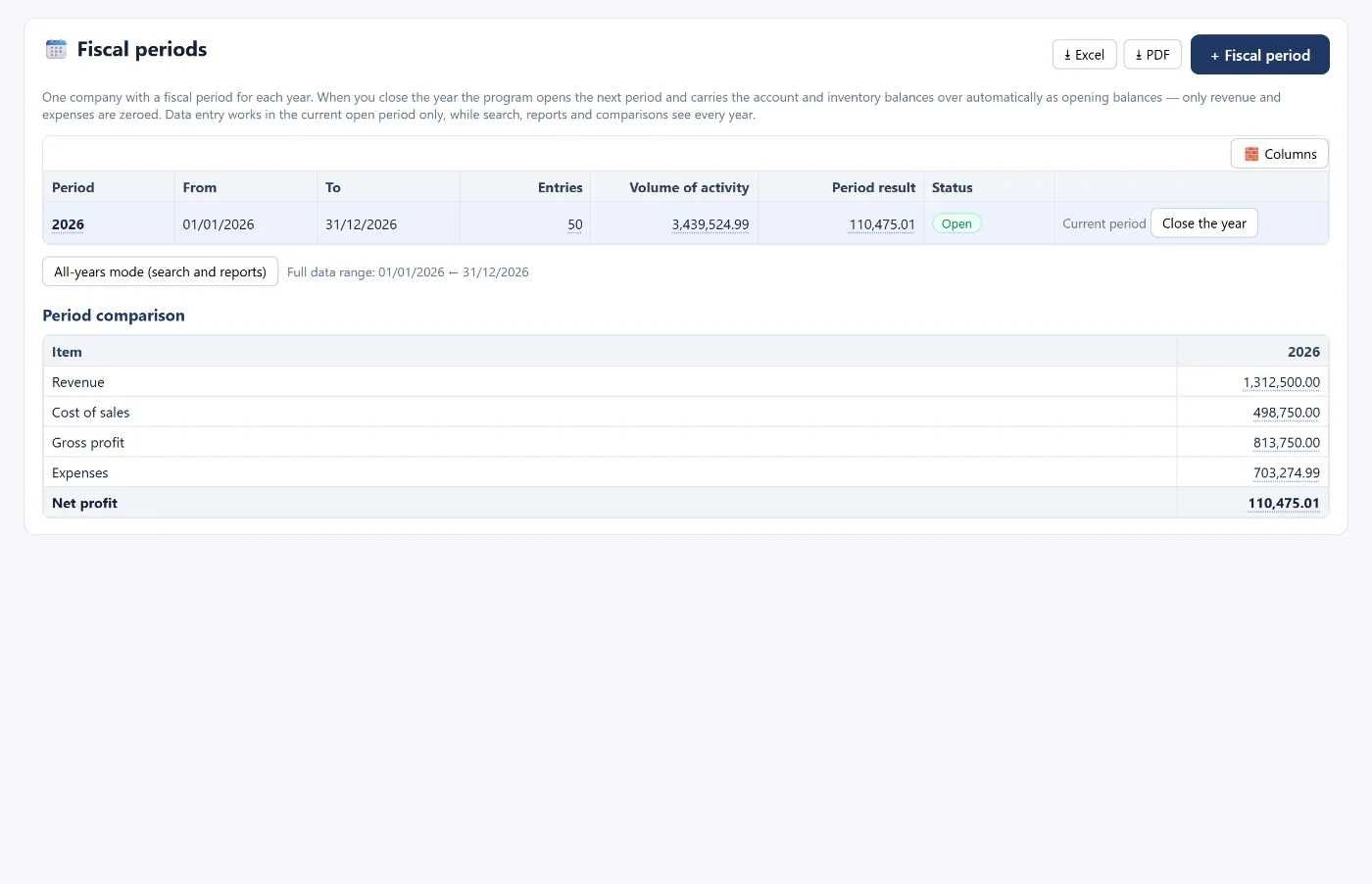
- Financial periods: one company with a period for each year. Closing a year opens the next period and carries account and inventory balances automatically as opening balances. Entry happens only in the open period, while search, reports and comparisons see all years.
FAQ
What is the difference between the monthly and yearly close?
The monthly close fixes the month's figures; the yearly close zeroes revenue and expenses into retained earnings and carries balances into a new year.
Are balance sheet accounts closed?
No. Asset, liability and equity balances carry forward as they are, as the new year's opening balances.
Can a closed year be changed?
In Tasaheel a closed period can only be reopened with the password it was closed with, so any change is deliberate and documented.
When should zakat be calculated?
Before closing, since its entry is part of the year's result; consult your zakat adviser and ZATCA on the method.
Read also how to read your financial statements, or learn more about Tasaheel Accounts.
Try it in Tasaheel: create a free account, record a year of activity, then review the closing entry before you approve it.