 Tasaheel ERP
Provisions: End-of-Service, Credit Losses and the Difference Entry
What provisions are and why they are booked: end-of-service benefits, expected credit losses by ageing matrix, other provisions, and posting only the difference.
 By Sherif Fadl — Founder, Tasaheel ERP
A provision is a liability or likely loss you know will happen but whose amount or timing is not certain: end-of-service benefits employees will earn, customer debts that may not be collected, or a case the business may lose. Recording them on time keeps profit closer to reality and avoids one big surprise in a single year.
End-of-service benefits
Under the Saudi Labour Law, a worker is entitled on termination to a benefit based on the last wage: half a month's wage for each of the first five years, and a full month's wage for each year after that, with part-years pro rata. On resignation the entitlement varies with length of service. The official reference is the Ministry of Human Resources and Social Development.
Example: an employee whose basic wage with qualifying allowances is SAR 10,000, with 7 years of service:
- First five years: 5 × half a month = 2.5 months = SAR 25,000.
- Next two years: 2 × one month = SAR 20,000.
- Benefit due (on termination by the employer or contract end) = SAR 45,000.
The business builds a provision for these obligations as they accrue, not only when an employee leaves. Businesses applying IAS 19 in full measure the obligation actuarially.
Expected credit losses
Under IFRS 9, credit losses are estimated before they happen. The simplest approach for businesses is an ageing matrix: a loss rate for each overdue band.
Example: customer receivables of SAR 500,000:
- Not overdue 300,000 × 1% = 3,000
- 1–90 days 150,000 × 5% = 7,500
- Over 90 days 50,000 × 20% = 10,000
- Required provision = SAR 20,500.
Posting only the difference
The common mistake is to book the full provision every period so it doubles up. The right way is to compare the required amount with the recorded amount (the provision's current balance) and post only the difference:
- Required 20,500 and recorded 15,000 → increase of 5,500: debit provision expense, credit the provision.
- Required 12,000 and recorded 15,000 → release of 3,000: debit the provision, credit provision expense (or release income).
How Tasaheel Accounts manages provisions
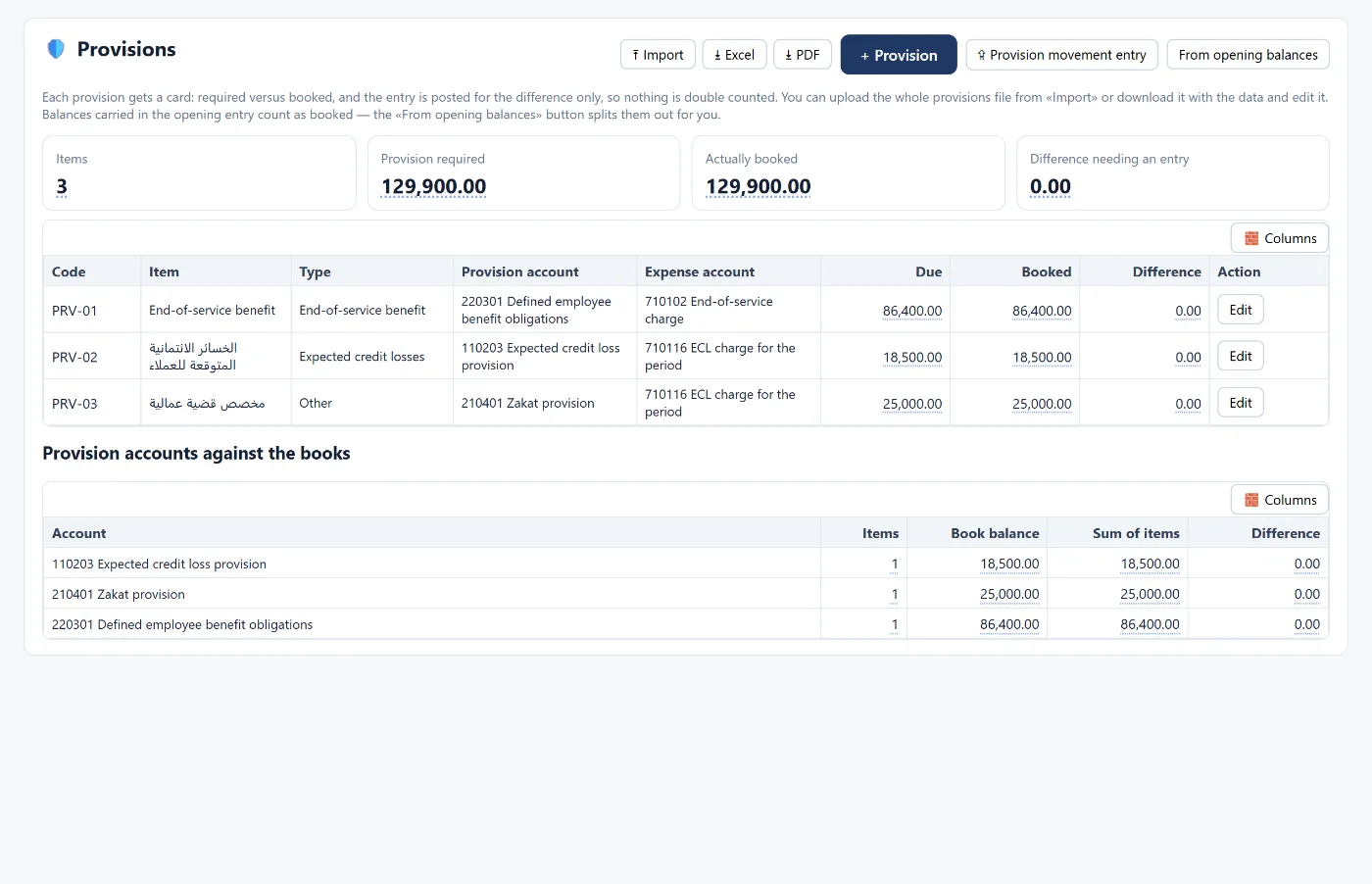
- The provisions screen: each provision has a card with its type (end-of-service, credit losses or other), provision account, expense account, required against recorded, and the difference — and the entry is posted for the difference only with the provision movement button, so nothing is doubled.
- From opening balances: balances coming from the opening entry count as recorded, and a button allocates them to the cards.
- Reconciliation of provision accounts to the books to confirm the recorded amount matches the account balance.
- Credit losses: an ageing matrix with a loss rate per band, the provision by difference, and IFRS 9 stages from days overdue automatically.
- End-of-service: the benefit calculation, and an actuarial valuation for those who need it.
FAQ
Is a provision an expense?
Creating or increasing a provision is charged as an expense for the period; the provision itself is a liability (or a contra account to the asset in the case of debts).
How often should I update provisions?
Monthly as part of the close gives more accurate figures, and at least yearly when preparing the statements.
What is the difference between a provision and a reserve?
A provision is for an expected liability or loss and is charged to profit; a reserve is an appropriation out of profit itself.
How do I calculate end-of-service benefits?
Half a month for each of the first five years and a month for each year after, on the last wage, with different entitlement on resignation. See the Labour Law for details.
Read also payroll and WPS and year-end close, or learn more about Tasaheel Accounts.
Try it in Tasaheel: create a free account, add your first provision card, and let the program post the difference.