 Tasaheel ERP
How to Read Your Financial Statements: A Guide for Owners
A plain guide to the income statement, balance sheet and cash flow, and the key ratios: margins, liquidity, collection days and break-even, with worked numbers.
 By Sherif Fadl — Founder, Tasaheel ERP
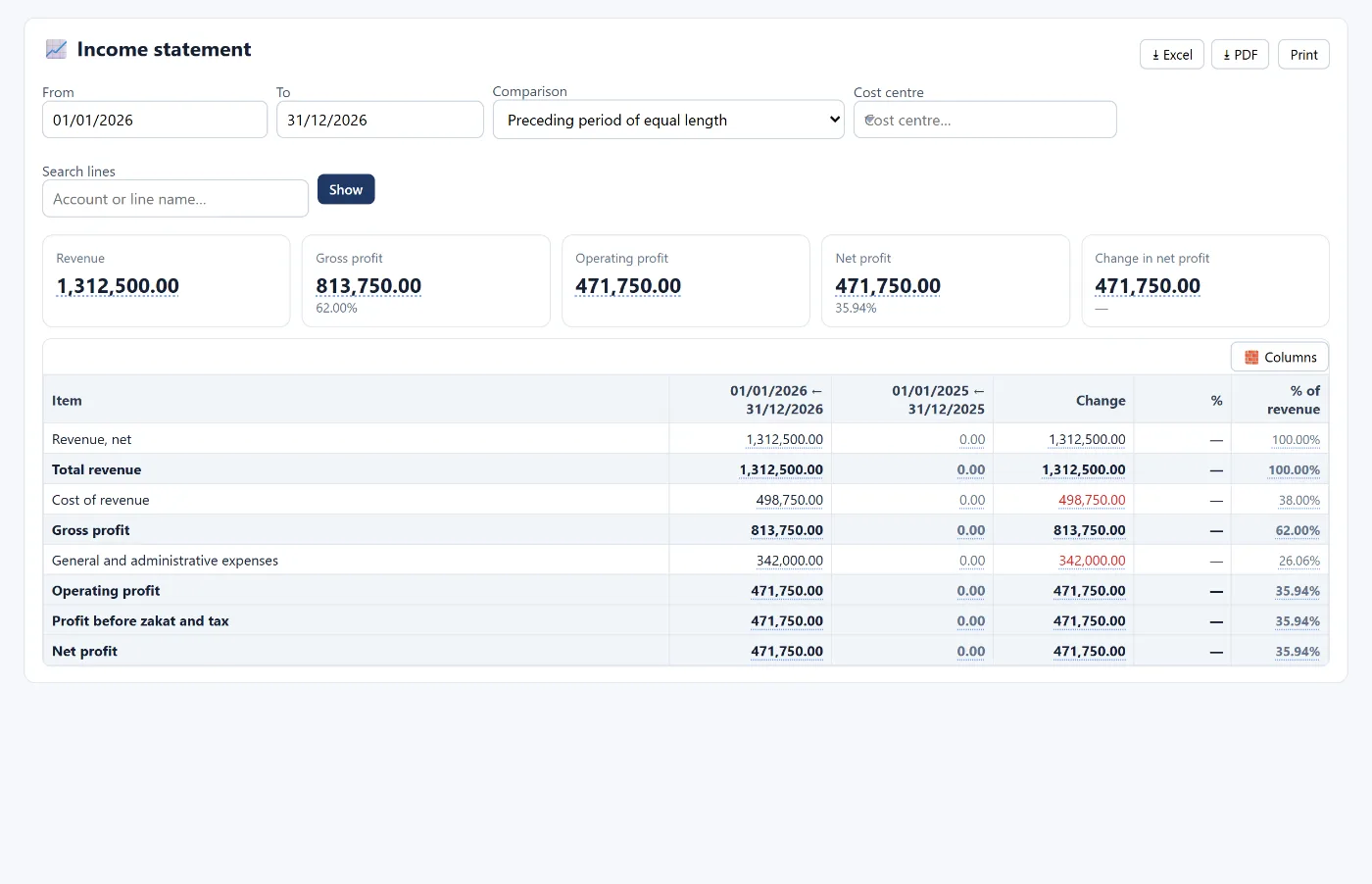
Many business owners receive financial statements from their accountant once a year and do not know what to read in them. In fact, three statements and five ratios are enough to tell you: are you making money? Do you have cash? Where is your money going? This guide explains them in plain language with examples.
1. The income statement: are you profitable?
It starts with revenue and subtracts costs in stages:
- Revenue: what you sold during the period.
- Cost of sales: the cost of the goods or service you sold.
- Gross profit = revenue − cost of sales.
- Operating expenses: salaries, rent, marketing and so on.
- Operating profit = gross profit − operating expenses.
- Net profit after other expenses and zakat or tax.
What to look at: each line as a percentage of revenue, compared with the prior period. If cost of sales rises from 38% to 45% of revenue, there is a pricing, purchasing or waste problem — even if revenue itself grew.
2. The balance sheet: what you own and what you owe
A picture at a specific date:
- Current assets: cash, customers, inventory — what turns into cash within a year.
- Non-current assets: equipment, buildings, vehicles.
- Current liabilities: suppliers, accrued salaries, VAT — what you pay within a year.
- Non-current liabilities: long-term loans and the end-of-service provision.
- Equity: capital and retained earnings.
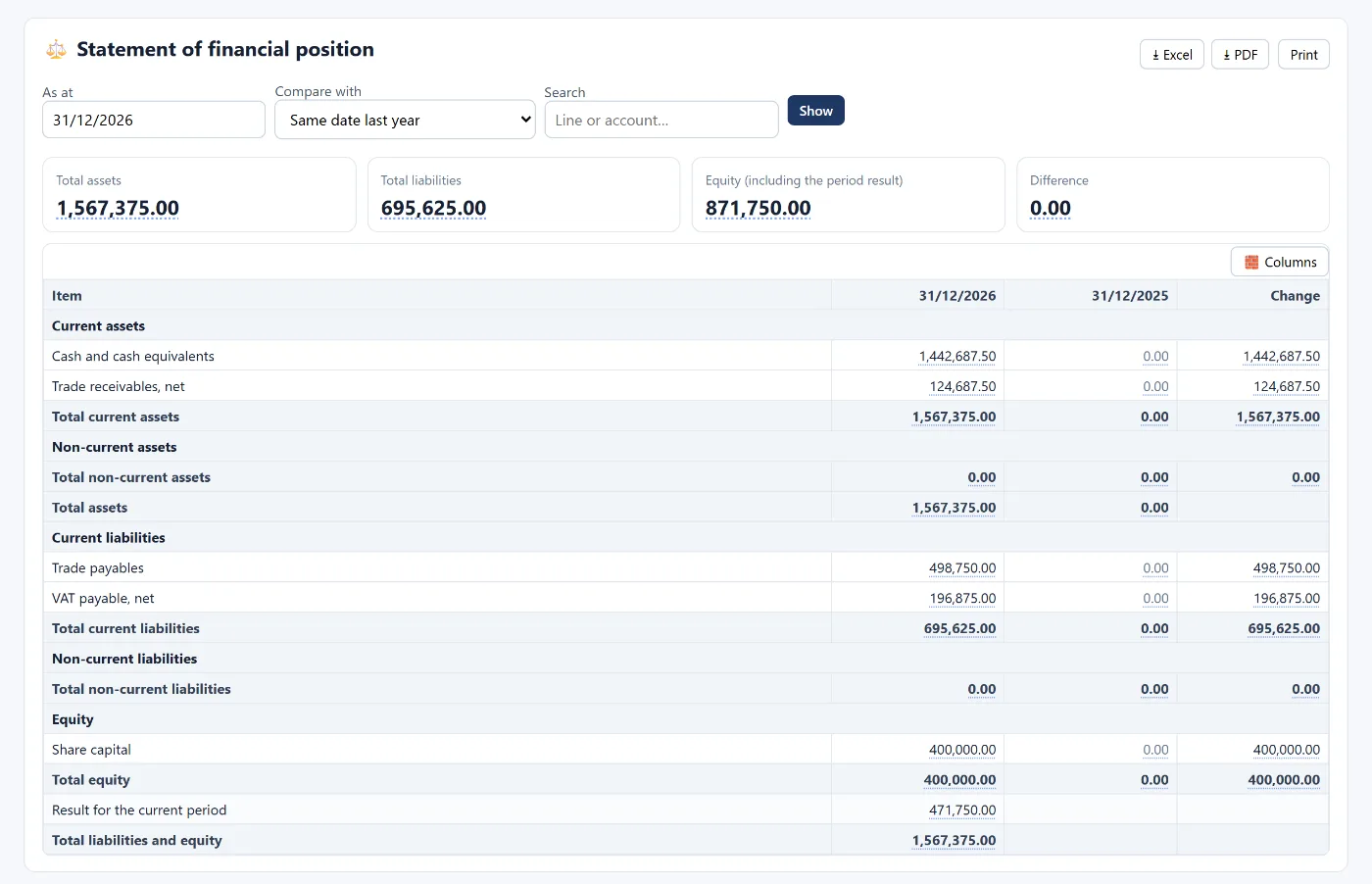
The equation always holds: assets = liabilities + equity.
3. The cash flow statement: where did the cash go?
Profit is not cash. You can make a profit and run out of cash because customers have not paid, or because you bought a lot of stock or equipment. The cash flow statement splits cash movement into:
- Operating activities: from day-to-day buying and selling.
- Investing activities: buying and selling assets.
- Financing activities: loans, capital and distributions.
Five ratios an owner needs
Worked numbers: revenue SAR 1,312,500, gross profit SAR 562,500, net profit SAR 200,000, current assets SAR 960,000, current liabilities SAR 480,000, and customer balances SAR 260,000.
- Gross margin = 562,500 ÷ 1,312,500 ≈ 43%: of every SAR 100 of sales, 43 remain after the cost of goods.
- Net margin = 200,000 ÷ 1,312,500 ≈ 15%.
- Current ratio = 960,000 ÷ 480,000 = 2: for every riyal due within a year you have two riyals of current assets.
- Collection days = 260,000 ÷ 1,312,500 × 365 ≈ 72 days: how long you wait on average to collect credit sales.
- Break-even: the sales that cover all fixed costs at your current margin. With fixed costs of SAR 362,500 and a contribution margin of 43%, break-even ≈ SAR 843,000.
Common reading mistakes
- Judging by revenue alone, ignoring margin.
- Confusing profit with cash.
- Comparing month with month and ignoring seasonality; compare with the same month last year too.
- Ignoring collection days; growing credit sales can drain cash.
How Tasaheel Accounts shows them
- All four statements ready at any moment, because every invoice and voucher posts its entry: the income statement, balance sheet, cash flow and changes in equity, with prior-period comparison and each line as a percentage of revenue.
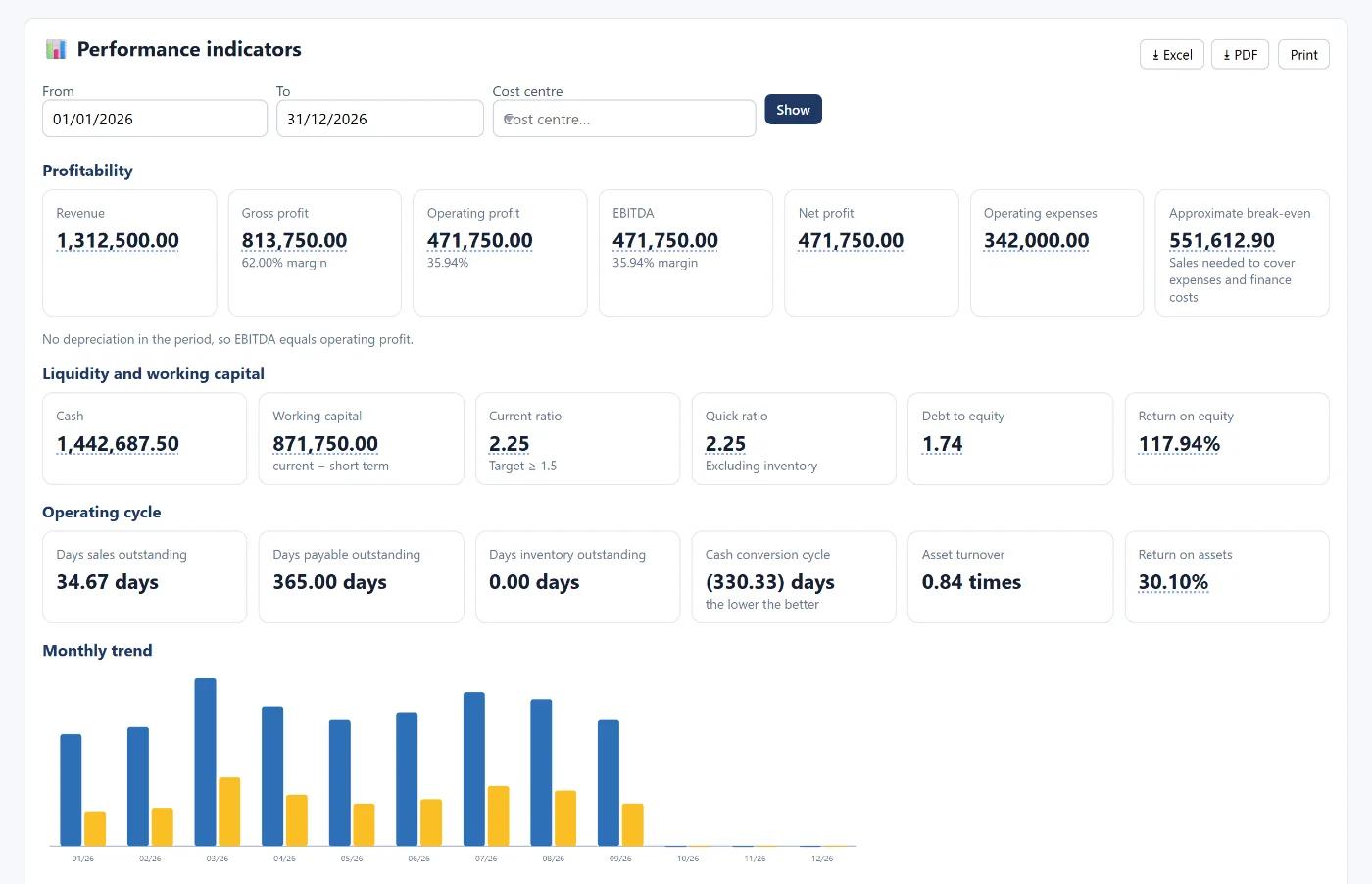
- KPIs: revenue, margins, EBITDA, liquidity, the operating cycle, collection and payment days and break-even on one board.
- Trace numbers: click any figure in a statement to see the entries behind it.
FAQ
How often should I read my financial statements?
Monthly, after the month is closed; reading them only once a year is too late to correct course.
Why am I profitable but short of cash?
Usually because part of sales is on credit and not yet collected, or cash went into stock, assets or loan repayments. Check the cash flow statement and collection days.
What is a healthy current ratio?
It varies by business, but below 1 means short-term liabilities exceed current assets, which needs attention.
What is the difference between operating and net profit?
Operating profit comes from the core business before other expenses, financing and zakat or tax; net profit is after all of them.
Read also month-end close and accounting software for restaurants, or learn more about Tasaheel Accounts.
Try it in Tasaheel: create a free account, record a month of activity, and open the KPI board to see your five ratios.