 Tasaheel ERP
Month-End Close: A Checklist for Small Businesses
A practical month-end close checklist: bank reconciliation, depreciation, prepaid expenses, provisions, VAT, the trial balance, and when to lock the period and why.
 By Sherif Fadl — Founder, Tasaheel ERP
Closing the month is not just for auditors. It is what makes a month's numbers final enough to base a decision, a VAT return or a financing request on. A business that never closes monthly finds its mistakes months later, when they are hard to trace. This guide gives a practical checklist and shows how Tasaheel Accounts helps with each item.
Why close the month?
- Fixed numbers: once closed, a month shown to management or the bank does not change.
- Correct VAT: the return rests on a period that does not move after filing.
- Smaller errors: a mistake found within a week is far easier than one a year old.
- Faster audits: the external auditor finds monthly reconciliations ready instead of starting from scratch.
Month-end close checklist
1. Sales and purchases
- All of the month's invoices are posted, with no drafts left.
- Returns are recorded in their month.
- Late supplier invoices are recorded with their correct date.
2. Cash and banks
- Bank reconciliation: each bank statement matches the books, and every difference is explained.
- Employee advances and petty cash are settled.
- Cashier shifts are closed and their differences posted.
3. Customers and suppliers
- Receivables ageing reviewed, with a provision for doubtful debts.
- Supplier balances agreed with their statements.
4. Recurring entries
- Depreciation of fixed assets for the month.
- Amortisation of prepaid expenses (rent, insurance, prepaid subscriptions).
- Deferred revenue earned in part.
- Accruals: the month's expenses whose invoices have not arrived yet (electricity, fees).
- End-of-service provision for employees.
5. Inventory
- Physical or cycle count of key items, with differences adjusted.
- Cost of sales calculated with the approved valuation method.
6. VAT
- The month's VAT report reviewed, and any month that breaks the pattern explained. Read how to calculate VAT and file the return.
7. Final review
- The trial balance balances, with no odd balances (negative cash, a supplier on the wrong side).
- The income statement compared with last month, with a reason for every big change.
- Balance sheet reconciliation of every important account against a document.
8. Close
- Record the close status and lock the period against new entries.
How Tasaheel Accounts helps
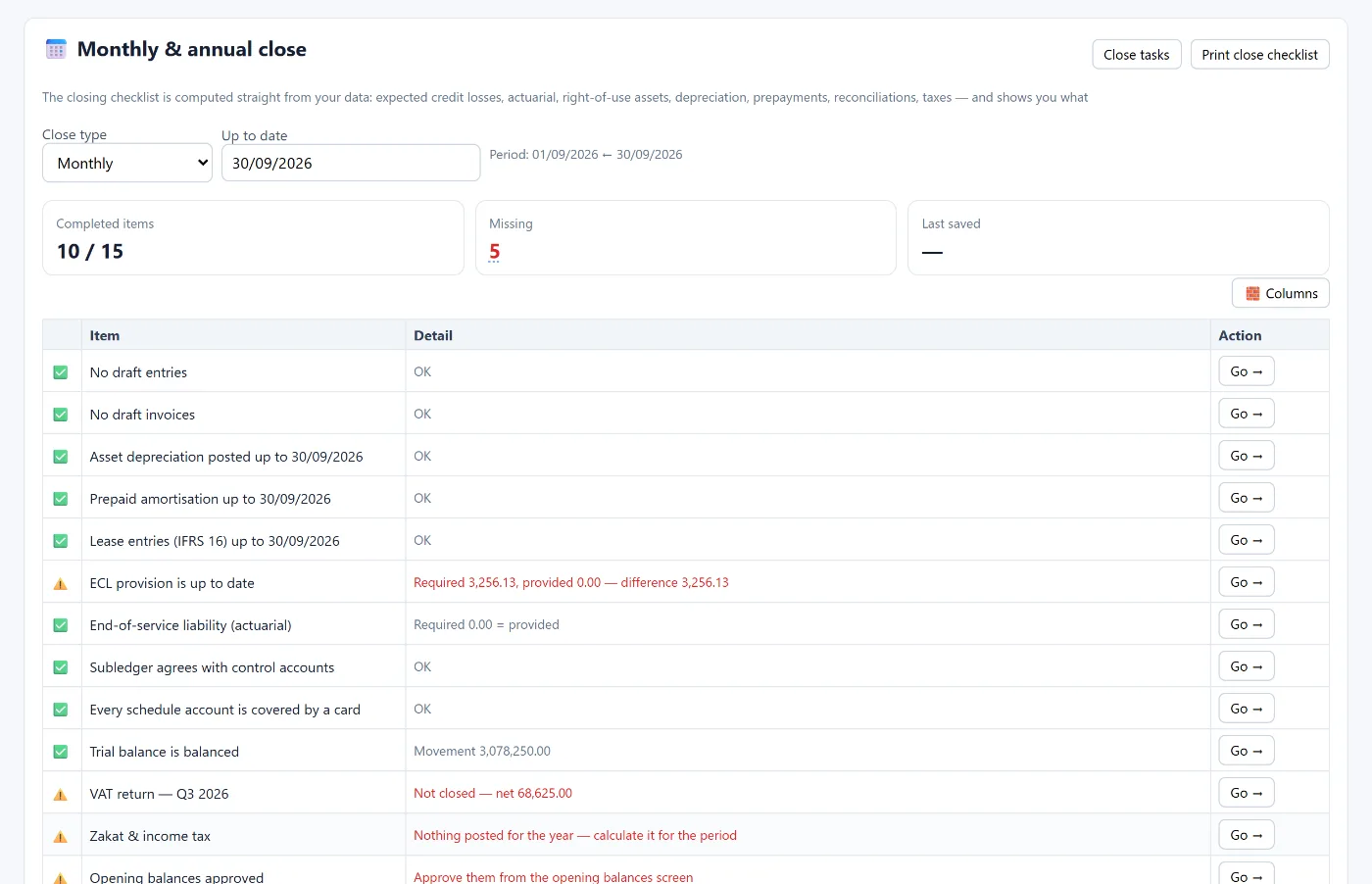
- Monthly and yearly close: a checklist calculated from your data — credit loss provision, actuarial valuation, right-of-use assets, depreciation, prepayments, reconciliations and taxes — shows what is missing, and each missing item has a button that opens the right screen. When done, saving the close status locks the period against new entries.
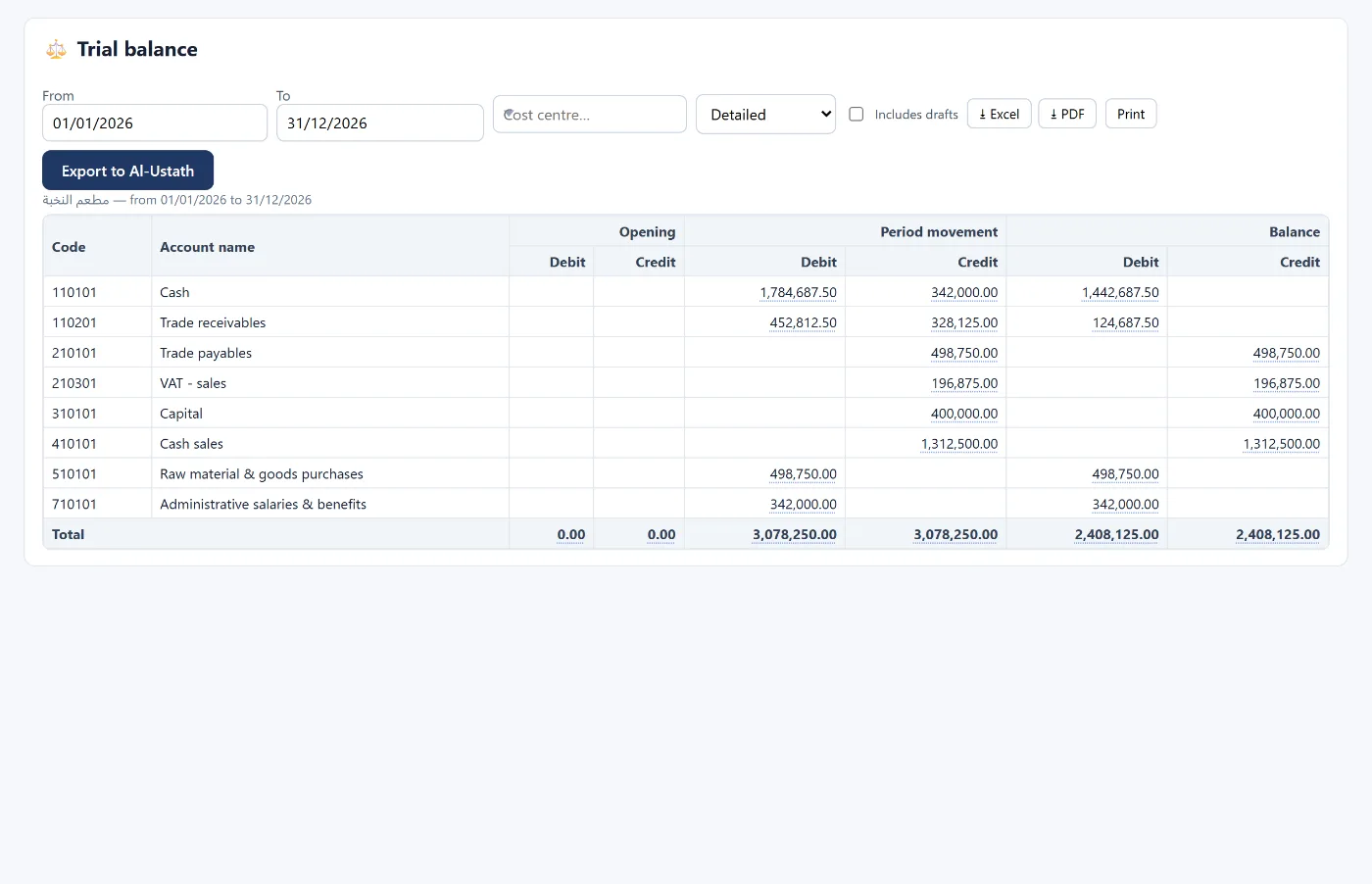
- Trial balance: opening balance, period movement and closing balance for every account, with an export for the auditor.
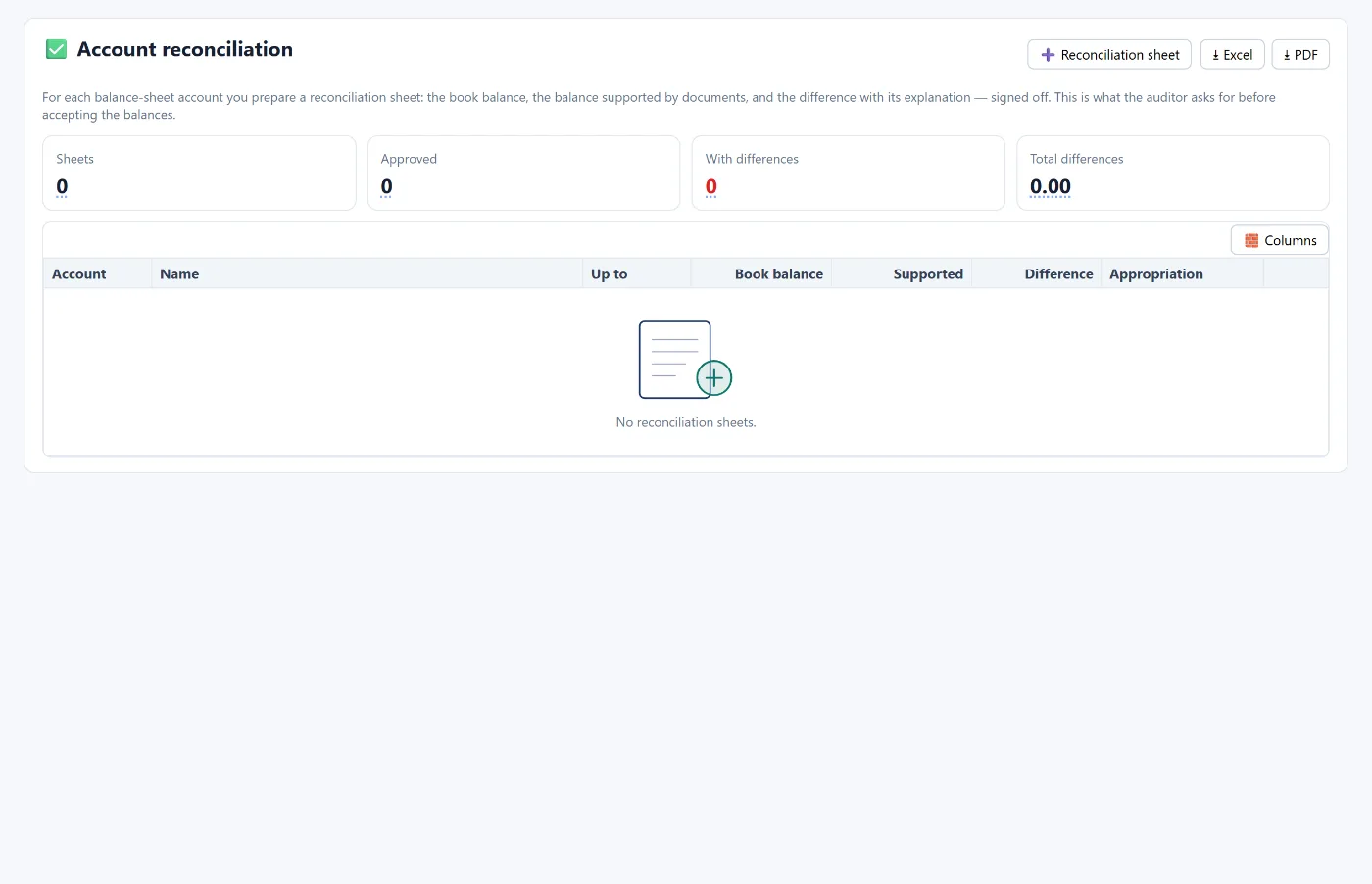
- Account reconciliation: a reconciliation sheet for every balance sheet account: book balance, balance supported by a document, the difference and its explanation, and sign-off — what the auditor asks for before accepting balances.
- Trace numbers: type an account or an amount, or click any figure on any screen, to see every entry behind it and its effect on the statements.
How long does it take?
In a small business that records invoices as they happen, a month can be closed in one to three working days. Most of the time usually goes on bank reconciliation and chasing late supplier invoices, so recording invoices daily and reconciling the bank weekly shortens the close a lot.
FAQ
What is the difference between a monthly and a yearly close?
The monthly close fixes the month's numbers; the yearly close ends the financial year, carries its result to equity and starts a new year, with extra entries such as zakat or income tax.
Can I post an entry in a closed month?
In Tasaheel a closed month does not accept new entries — that is what keeps reported numbers fixed. For VAT specifically, any entry landing in a locked return period shows as an adjustment in the next period.
Who should close the month?
The accountant prepares the items, and the finance manager or owner reviews and signs off; separating who records from who approves is best.
Is a monthly close mandatory?
What is legally required is the annual statements and the tax returns on time; the monthly close is the practical way to get there without surprises.
Read also accounting software for contractors and e-invoicing in Saudi Arabia, or learn more about Tasaheel Accounts.
Try it in Tasaheel: create a free account, record a month of activity, and open the monthly close to see what is missing before you close.