 Tasaheel ERP
Fixed Assets and Depreciation: Straight-Line and Declining
A practical guide to fixed assets: cost, useful life and residual value, straight-line and double-declining depreciation, entries, revaluation and disposal.
 By Sherif Fadl — Founder, Tasaheel ERP
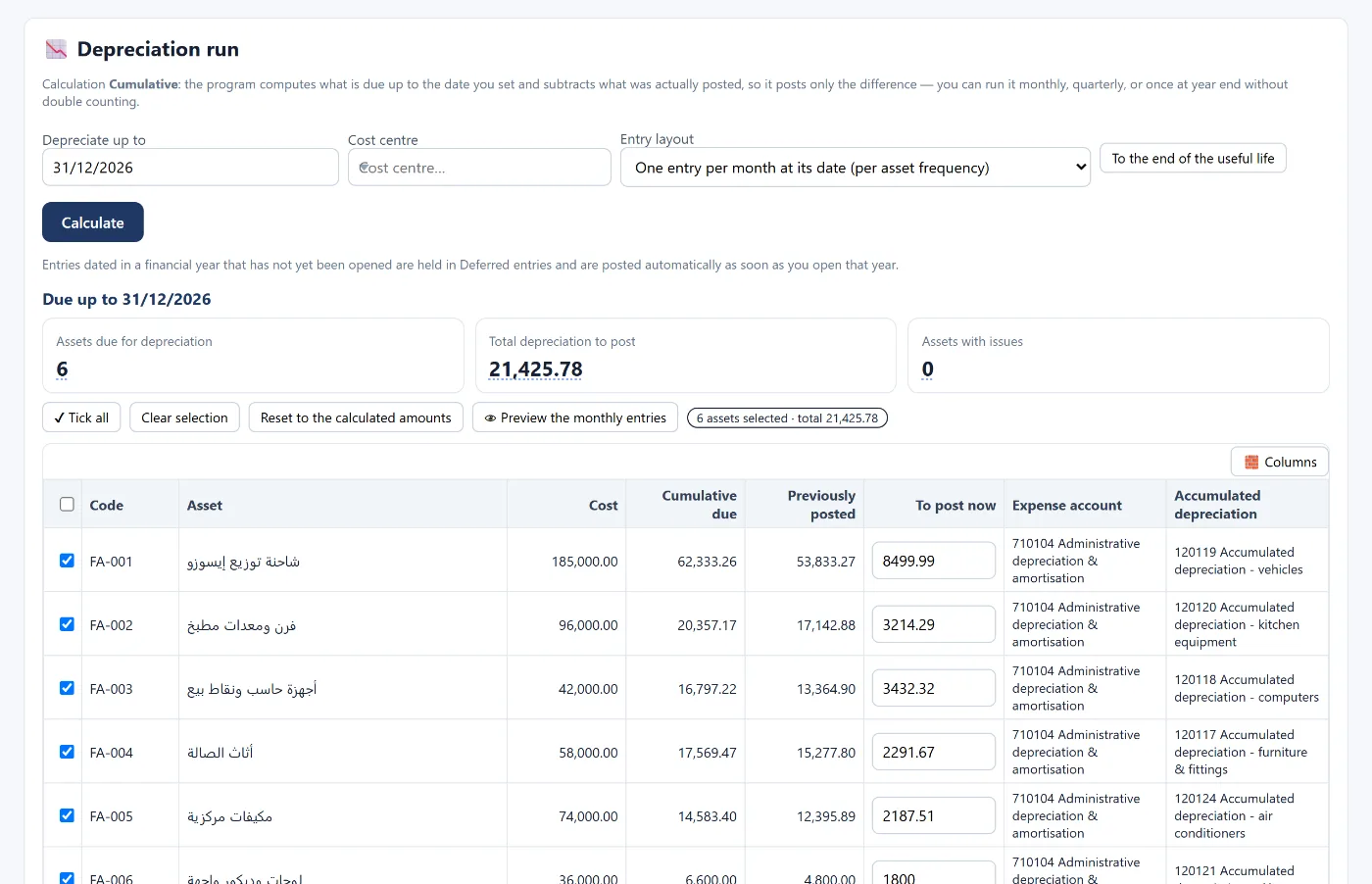
Vehicles, equipment, computers and furniture serve a business for years, so their cost is not expensed at once but spread over their useful life through depreciation. This guide explains how assets are recorded and how depreciation is calculated by the two most common methods, with examples and entries.
Three figures for every asset
- Cost: the purchase price and everything needed to make the asset ready for use (shipping, installation).
- Useful life: how long the asset is expected to be used.
- Residual value: what it is expected to sell for at the end of its life.
Depreciable amount = cost − residual value.
Straight-line
The same depreciation every period.
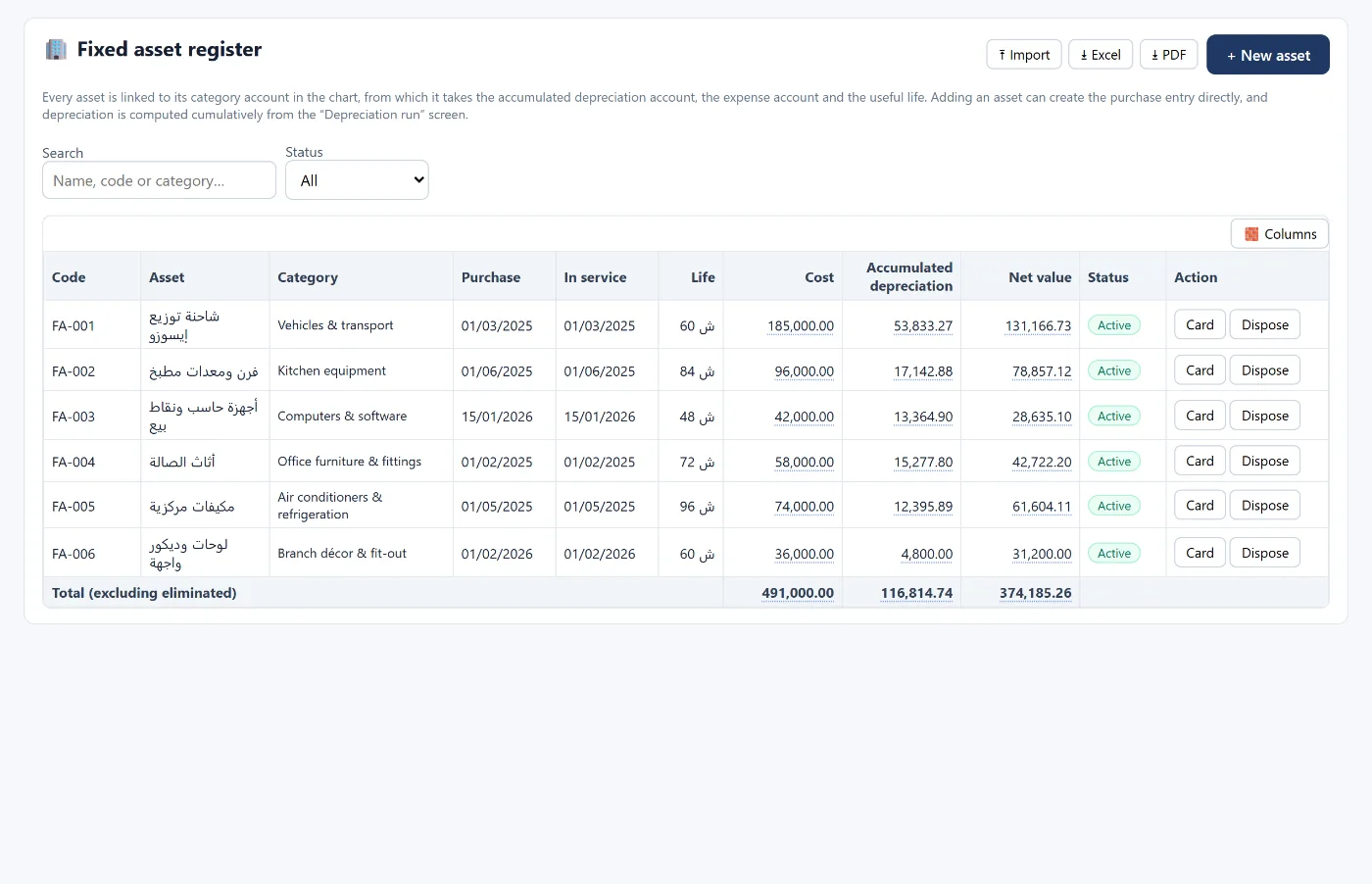
Example: a delivery truck costing SAR 185,000, residual value SAR 15,000, life 5 years (60 months), in service from 1 March 2025.
- Depreciable amount = SAR 170,000.
- Monthly depreciation = 170,000 ÷ 60 ≈ SAR 2,833.
- To 30 September 2026 (19 months) = 19 × 2,833.33 ≈ SAR 53,833, leaving a net book value of ≈ SAR 131,167.
Double-declining balance
More depreciation in the early years; suits assets that lose value quickly, such as computers. Annual rate = 2 ÷ life, applied to the net book value at the start of each period.
Example: computers costing SAR 42,000 with a 4-year life. Rate = 50% a year.
- Year 1: 42,000 × 50% = SAR 21,000, leaving 21,000.
- Year 2: 21,000 × 50% = SAR 10,500, leaving 10,500.
The depreciation entry
- Debit depreciation expense (or depreciation within cost of sales for production assets)
- Credit accumulated depreciation for the category (vehicles, equipment, computers…)
Accumulated depreciation is a contra account deducted from cost on the balance sheet, so cost, accumulated depreciation and net value all show.
Revaluation and disposal
- Revaluation (if the business uses the revaluation model under IAS 16): an increase over book value goes to the revaluation surplus in equity, unless it reverses a loss previously charged to profit or loss. A decrease is charged to profit or loss, unless the asset has a previous surplus, which is reduced first.
- Disposal or sale: the asset and its accumulated depreciation are removed, and the difference between net value and the sale price is a gain or loss.
How Tasaheel Accounts manages assets
- Fixed asset register: each asset is linked to its category account in the chart, from which it takes the accumulated depreciation and expense accounts, with cost, life (in months), residual value, method (straight-line or double-declining) and posting frequency. Adding an asset can post the purchase entry directly.
- Depreciation run: up to a date you choose, the program calculates each asset's cumulative depreciation, subtracts what was posted before, and posts only the difference — monthly or combined — with a preview of monthly entries before you approve.
- Asset revaluation: enter fair value, and the program allocates the difference to the revaluation surplus or profit and loss according to the rule above.
FAQ
Which depreciation method should I choose?
Straight-line for assets used evenly over their life, declining for assets that lose value quickly. Consistency is what matters.
When does depreciation start?
From the date the asset is ready for use (in service), not the purchase date if they differ.
Is land depreciated?
No. Land is not depreciated because its life is unlimited, unlike the building on it.
How often should depreciation be posted?
Monthly gives more accurate monthly figures; quarterly or yearly is also possible.
Read also month-end close and year-end close, or learn more about Tasaheel Accounts.
Try it in Tasaheel: create a free account, add your first asset, then run its depreciation to date.