 Tasaheel ERP
Manufacturing Accounting Software — Production Orders and Costs
Accounting software for factories in Saudi Arabia and beyond: production orders costed with materials, labour and overhead, waste, variances and WIP.
 By Sherif Fadl — Founder, Tasaheel ERP
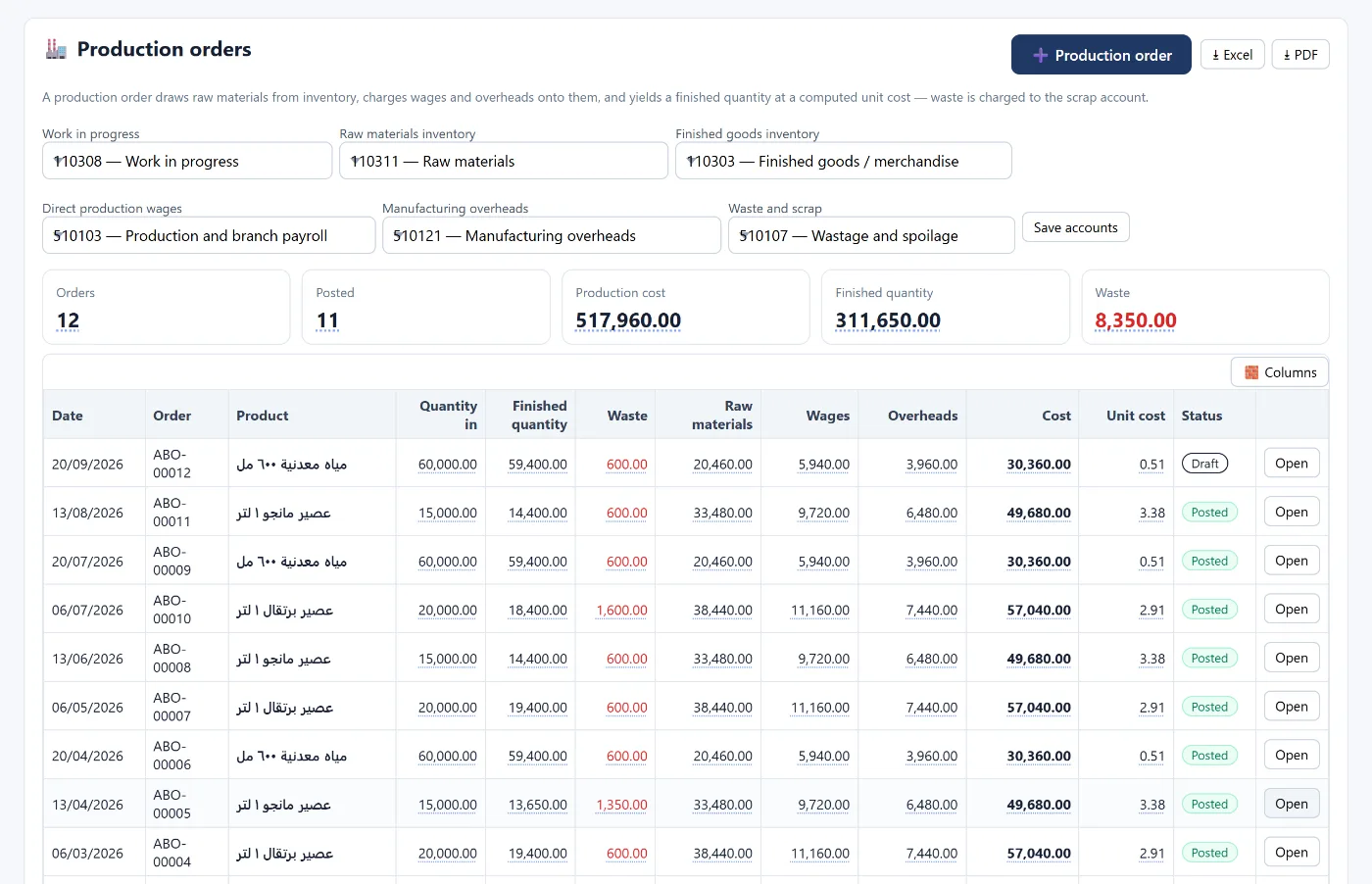
In a factory it is not enough to know sales and expenses; the real question is what did one unit cost? How much was lost in production? And why did cost rise this month — the price of materials or the process? Tasaheel Accounts costs every production order from materials, labour and overhead, separates normal from abnormal waste, and compares actual with standard.
Manufacturing accounting problems it solves
- Unit cost is an estimate, so pricing and profit are not accurate.
- All waste is loaded onto finished goods, inflating their value.
- Nobody knows why cost went up: quantity or price.
- Orders open for months lock materials and labour in the balance sheet with no output behind them.
Production orders
A production order takes materials from stock, loads direct labour and indirect manufacturing overhead on them, and produces a finished quantity at a calculated unit cost. Posting creates the whole entry: materials and costs to work in progress, then the transfer to finished goods.
Each order has the product, input and finished quantity, materials, labour and overhead, the allowed normal waste percentage, the standard yield and standard unit cost, and a cost centre.
Normal and abnormal waste
Under IAS 2, normal waste is part of product cost, while abnormal waste is an expense of the period, not inventory cost. You set the allowed waste for each order; what stays within it remains in product cost, and anything above it is charged to the waste account — so good units never carry the cost of lost ones.
Cost and usage variances
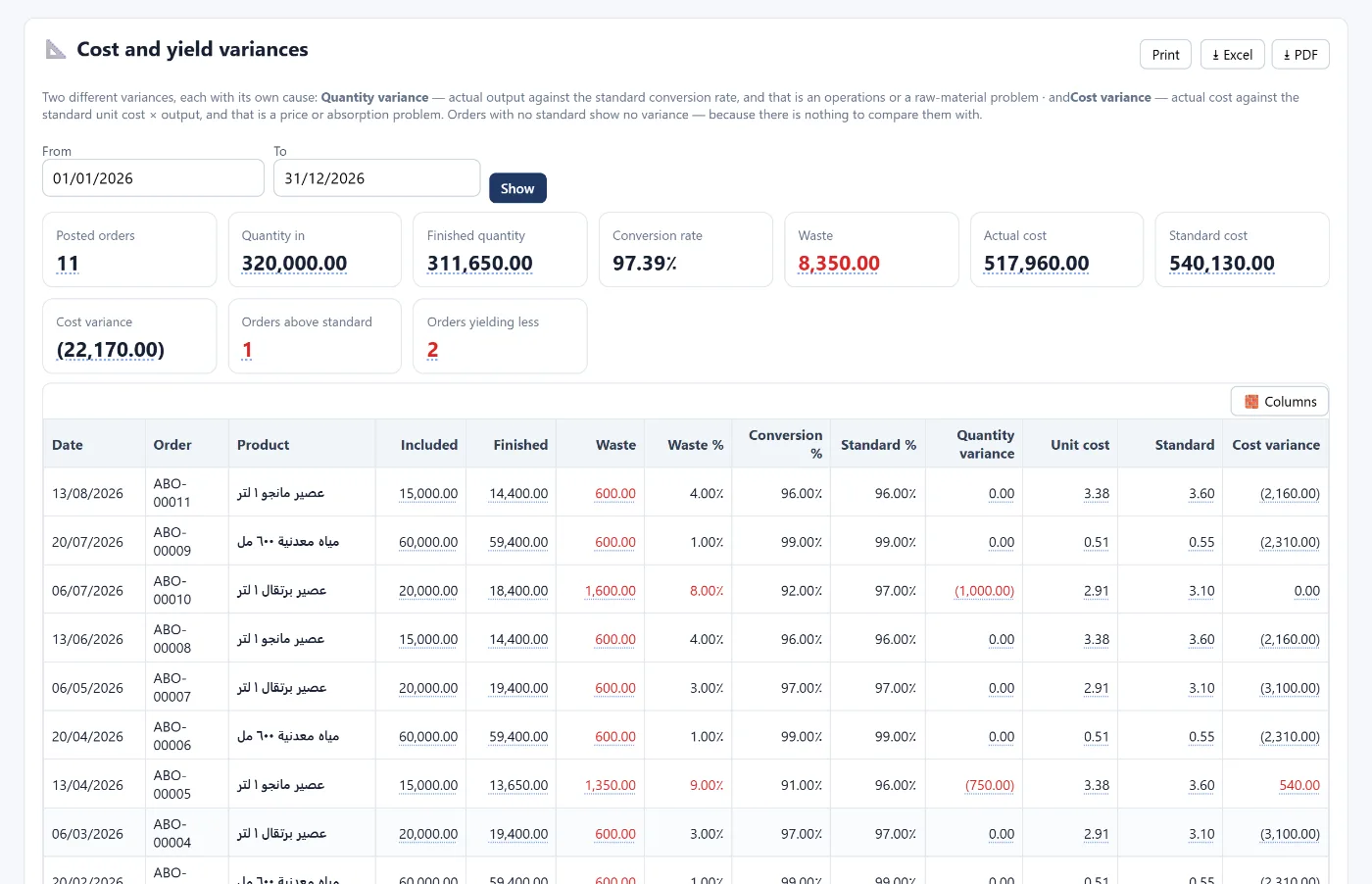
Two different variances, each with its own cause:
- Quantity variance: actual output against the standard yield — a process or materials problem.
- Cost variance: actual cost against standard unit cost × output — a price or allocation problem.
The screen shows the orders above standard and those below it.
Production and waste report
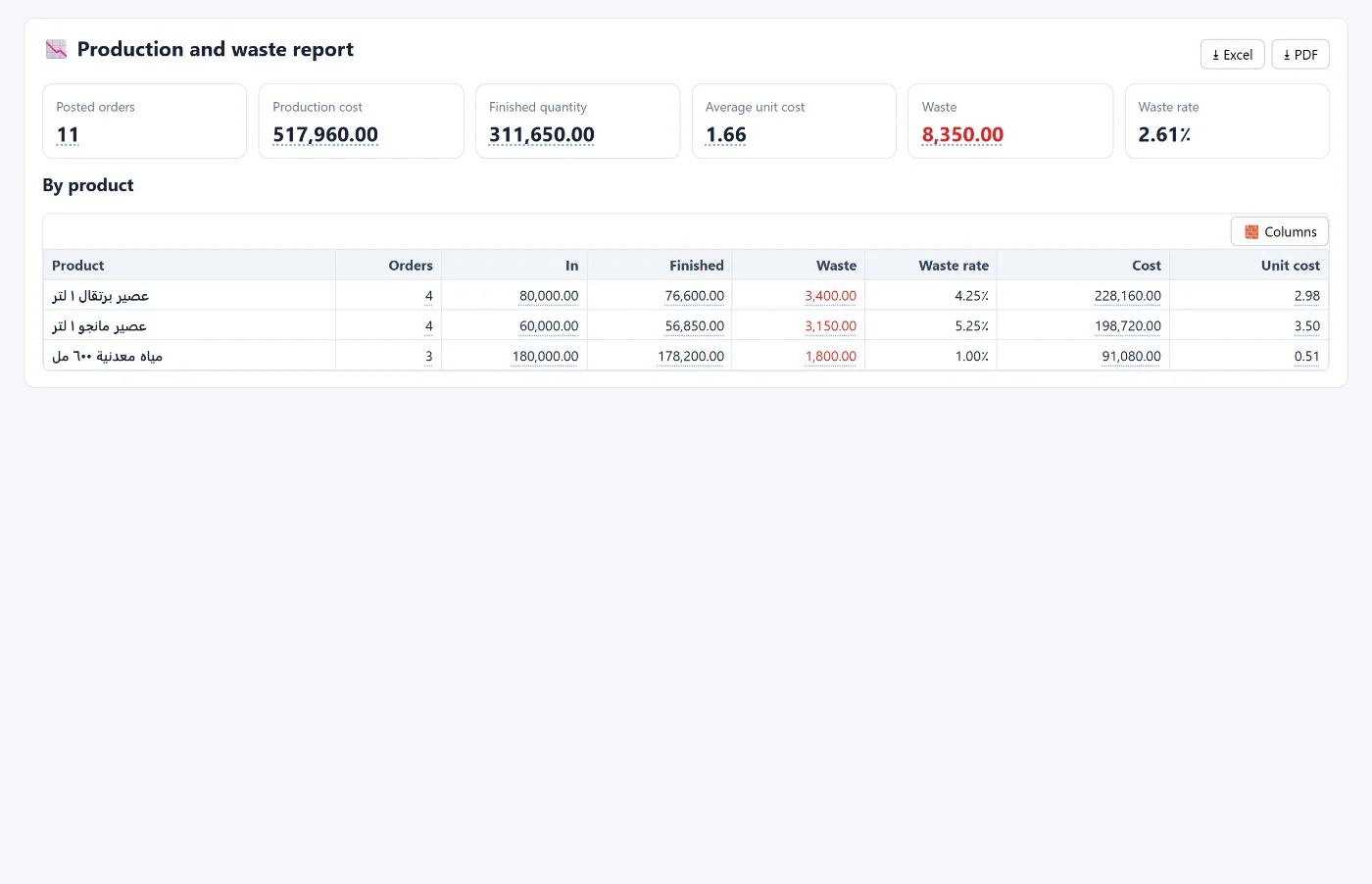
For each product: number of orders, input and output, waste and its rate, cost and unit cost — so you see which product loses the most.
Work in progress
An order opened and never closed locks materials and labour in work in progress — money in the balance sheet with no finished goods behind it. The screen lists open orders and their age, and those older than 30 days are the first thing an auditor asks about at stocktake.
Bills of materials and batches
- Product cost (bill of materials): each product's components, quantities and processing cost, so the program calculates unit cost, compares it with the selling price and shows the margin; a component can itself have components, up to 5 levels.
- Batches and expiry: each quantity received gets a batch number and an expiry date, with an alert for what is close to expiry and a write-off entry for what has expired.
How to start
- Create your account and choose the manufacturing activity.
- Set the production accounts once, from the production orders screen.
- Define products, their components and standard yields.
- Record and post the first production order.
Learn more about Tasaheel Accounts or read the user guide.
FAQ
How is the unit cost of a product calculated?
From the materials, direct labour and overhead loaded on the production order, divided by the finished quantity, after separating abnormal waste.
What is the difference between normal and abnormal waste?
Normal waste is within the allowed rate and stays in product cost; abnormal waste is anything above it and is expensed to the waste account.
Does it compare actual cost with standard?
Yes, in cost and usage variances: a quantity variance against the standard yield, and a cost variance against the standard unit cost.
Does it support multi-level bills of materials?
Yes, up to 5 levels, with unit cost and margin against the selling price.
Is it suitable for food factories?
Yes, with batches and expiry dates. See also stock counts and valuation and accounting software for wholesale.
Try it in Tasaheel: create a free account, choose the manufacturing activity, and record your first production order to see unit cost and waste.