 Tasaheel ERP
Software for Audit Firms and Chartered Accountants
Software for audit firms in Saudi Arabia and beyond: engagements and stages, materiality, statistical sampling, the audit programme, team hours and profit.
 By Sherif Fadl — Founder, Tasaheel ERP
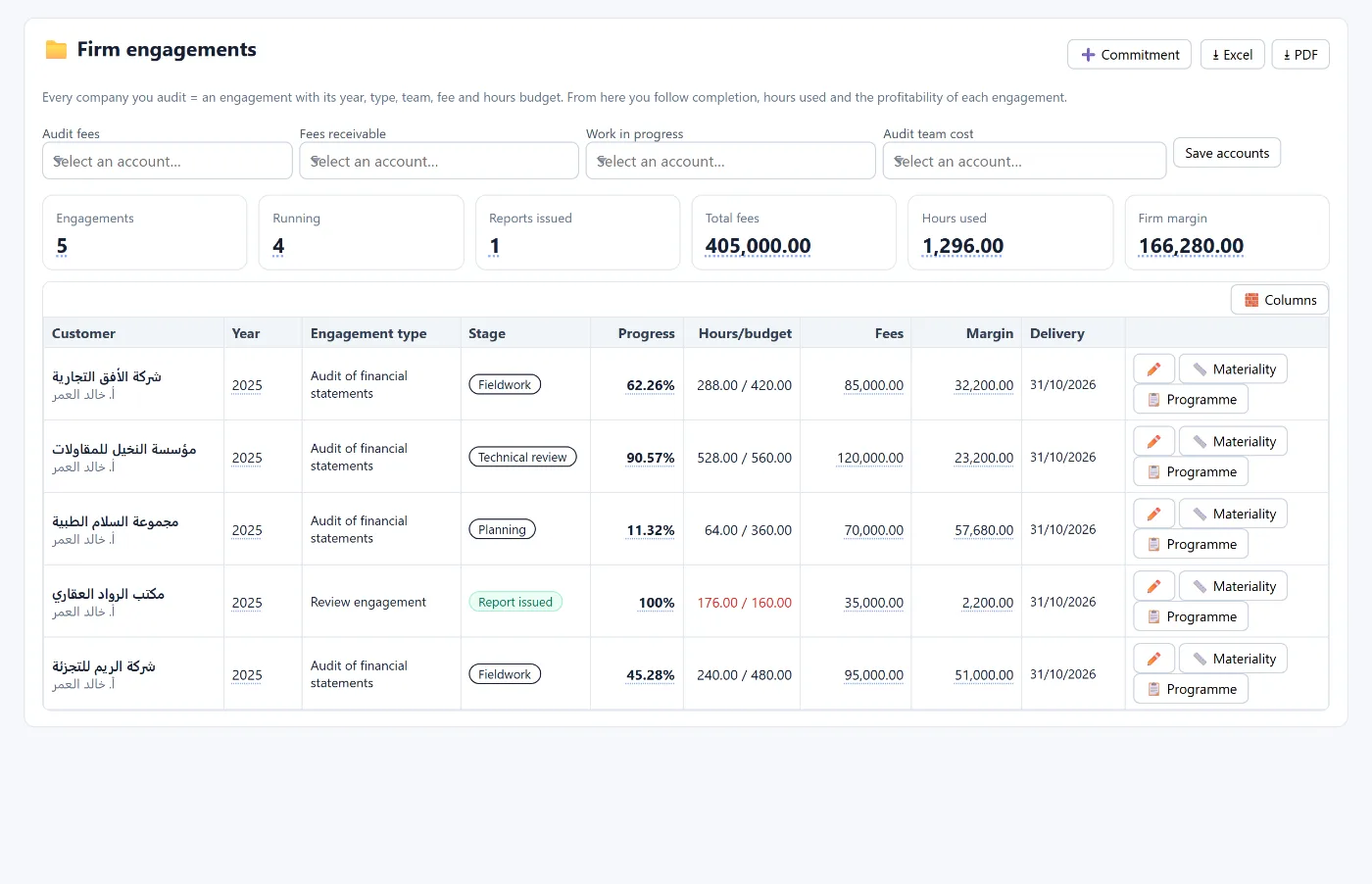
An audit firm sells time and expertise, so its profit leaks in two places: an engagement that eats more hours than its fee, and a file nobody knows the status of. Tasaheel Accounts includes a full module for audit firms: from engagement planning and materiality, to the audit programme and team hours, to the profit of each engagement — alongside the firm's own accounts.
Audit firm problems it solves
- Nobody knows where each engagement stands without asking the team.
- Hours run over budget and the partner only notices at the end.
- Materiality and sample size are worked out in separate Excel files for each client.
- Engagement profit is unknown, so the next engagements are priced by guesswork.
Firm engagements
Each audited company is an engagement with its year, type (financial statement audit, limited review, agreed-upon procedures…), team (partner, manager, staff), fee, budgeted hours, due date and stage (planning, fieldwork, technical review, draft report, report issued). From the same screen you follow completion, hours used against budget, and each engagement's margin.
Firm dashboard
Engagements by stage, fees, hours, average completion and margin — the whole firm on one screen for the partner.
Materiality
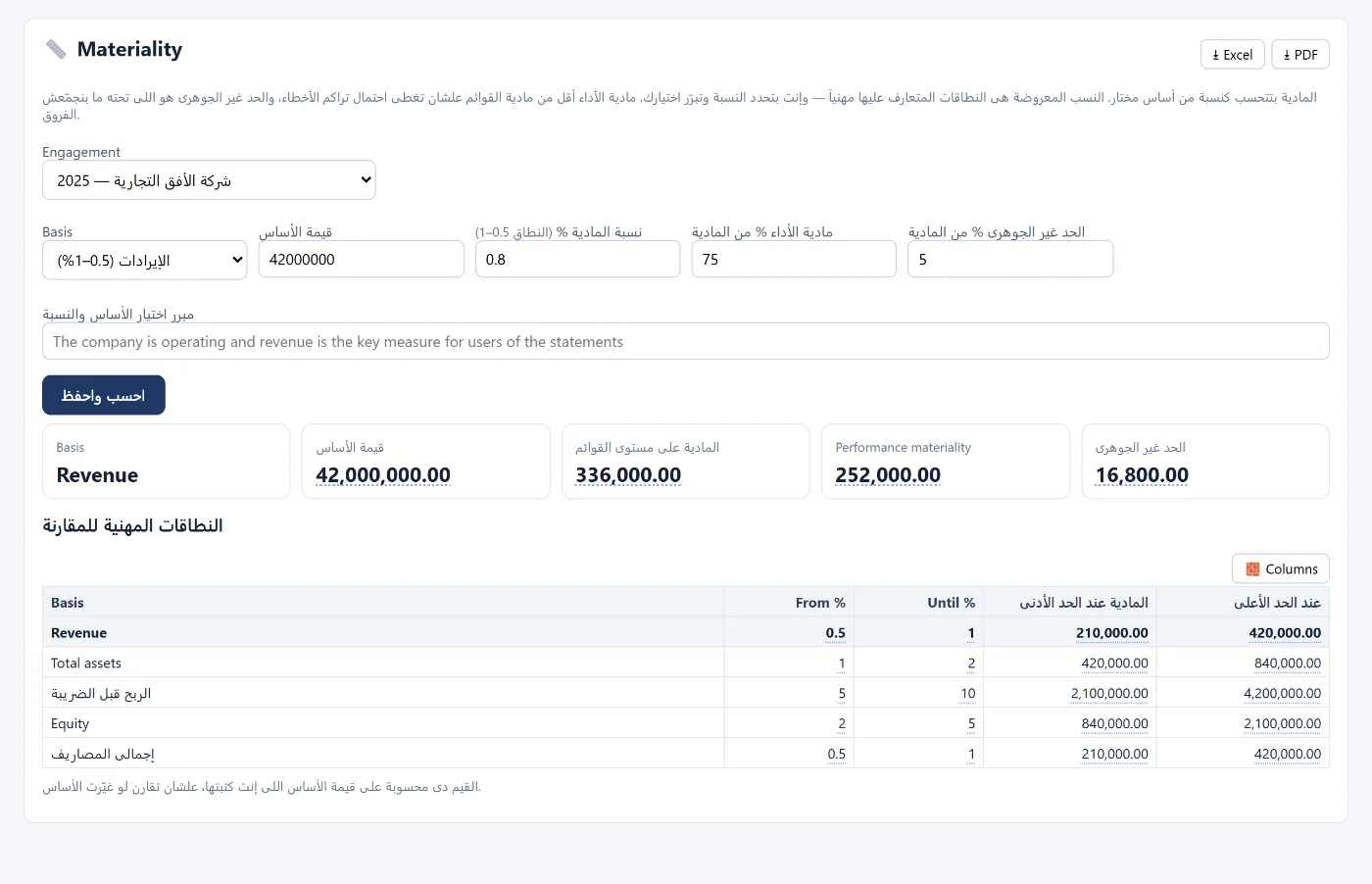
Materiality is calculated as a percentage of a chosen base (revenue, total assets or others), with the customary professional ranges shown for comparison; you set the percentage and justify your choice. Performance materiality is set below overall materiality to cover the risk of aggregated errors, together with the clearly trivial threshold below which differences are not accumulated.
Statistical sampling
Sample size uses monetary unit sampling (MUS): population value × confidence factor ÷ performance materiality. Upload the transactions file, and the program calculates the size and draws the sample — by monetary interval, randomly or by the largest amounts — and produces the sample sheet ready for the working paper, saved to the engagement.
The audit programme
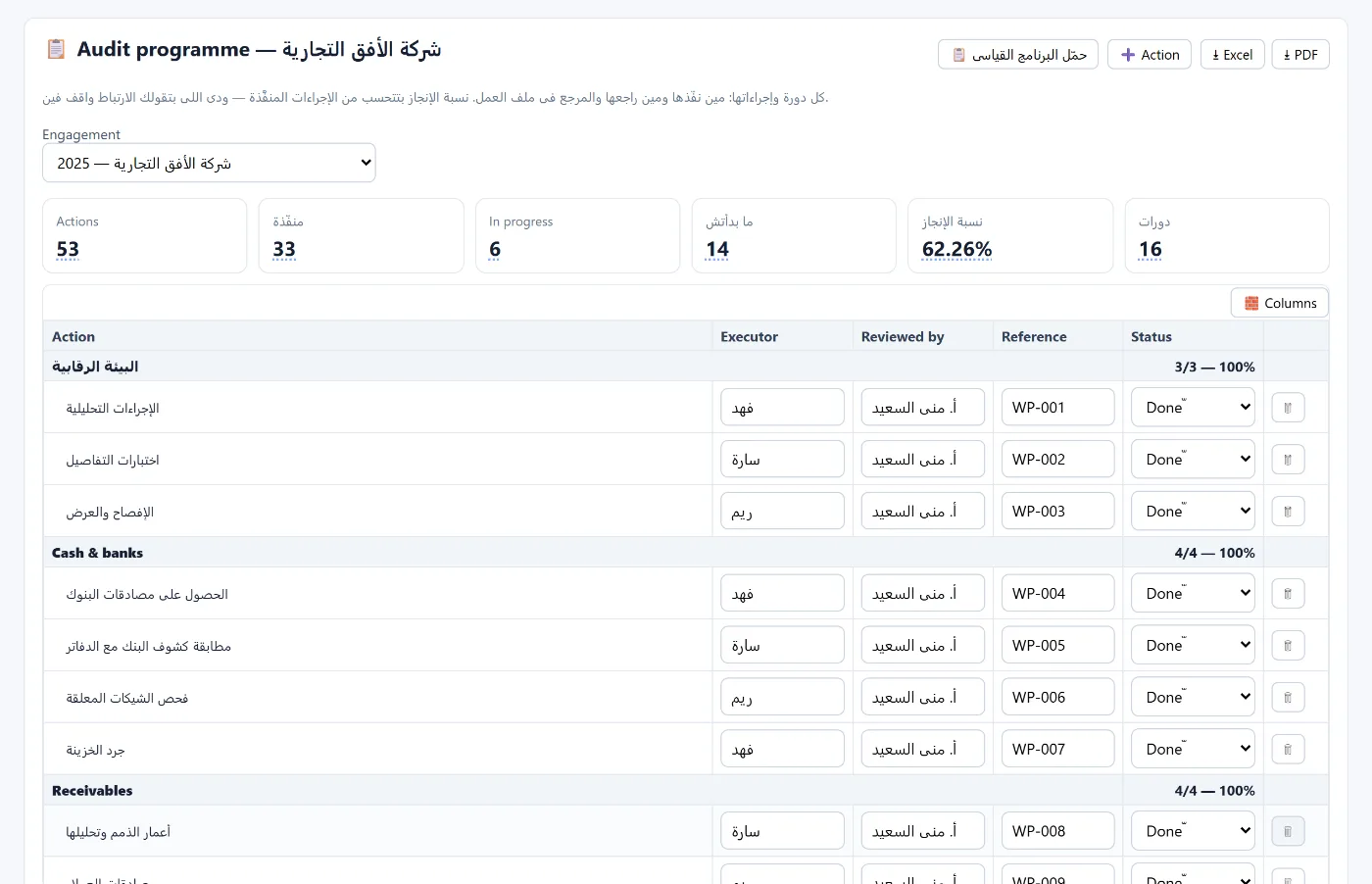
Each cycle (control environment, cash and banks, receivables, inventory, fixed assets, payables…) has its procedures: who performed it, who reviewed it, the working paper reference and its status. The standard programme loads in one click and can then be edited, and completion is calculated from performed procedures — so you know where the engagement stands.
Audit hours and engagement profit
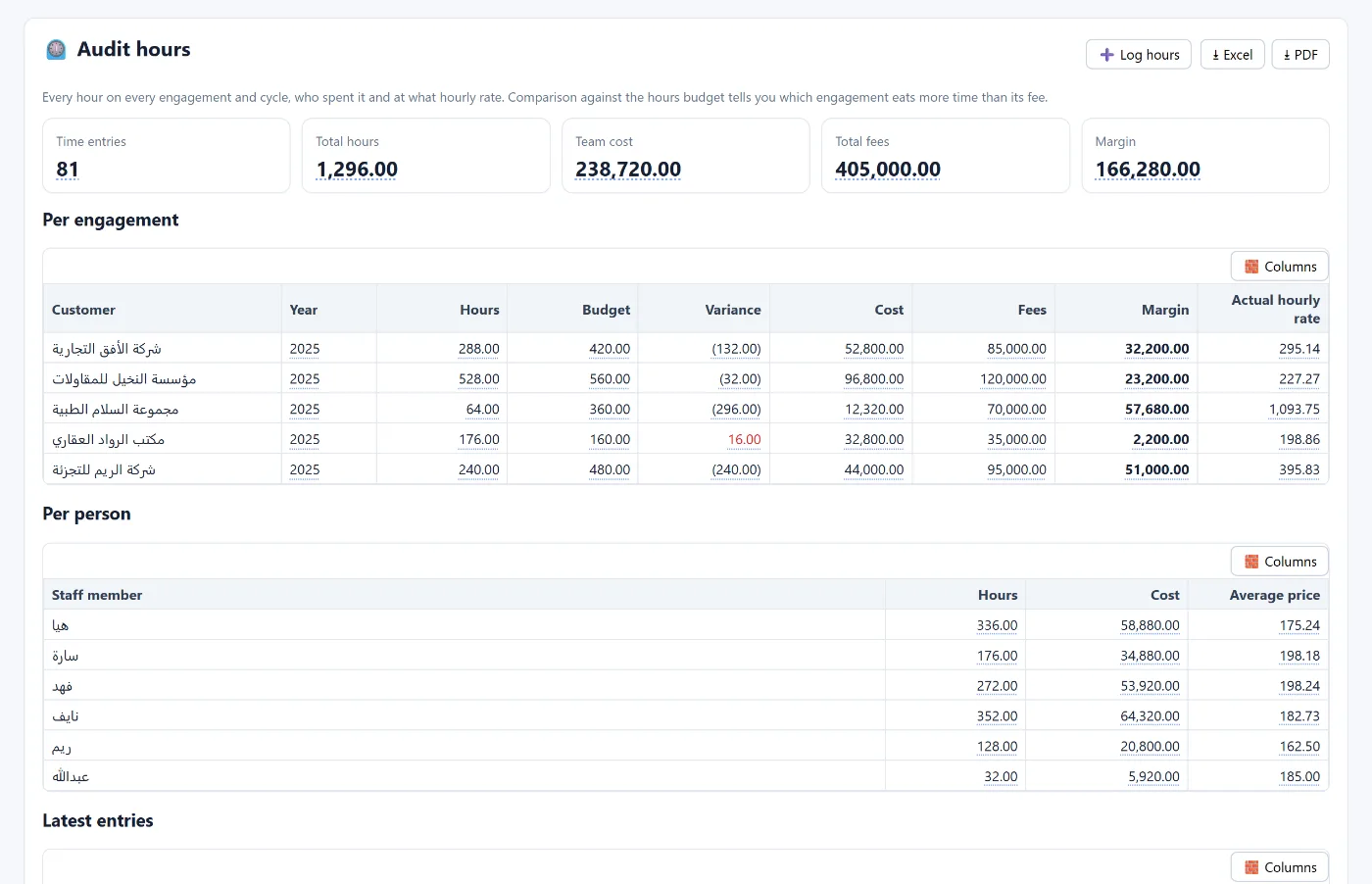
Every hour on any engagement and cycle, who did it and at what rate. Comparing with budgeted hours shows the engagement that uses more time than its fee, with cost, margin and effective hourly rate per engagement, and hours per team member.
The firm's own accounts
Alongside the audit module: fee billing and receivables, unbilled work in progress, employees and payroll, fixed assets, and the month-end close — see month-end close.
How to start
- Create your account and choose the audit firms activity.
- Add the first engagement with its fee, budgeted hours and team.
- Calculate materiality, and load the standard audit programme.
- Record team hours and follow completion and margin.
Learn more about Tasaheel Accounts or read the user guide.
FAQ
How does it calculate materiality?
As a percentage of a base you choose (such as revenue or total assets), with performance materiality and the clearly trivial threshold, and professional ranges shown for comparison.
How is sample size calculated?
By monetary unit sampling (MUS): population value × confidence factor ÷ performance materiality, drawing the sample by monetary interval, randomly or by largest amounts.
Can I track each team member's hours?
Yes. Each hour carries the engagement, cycle, person and rate, with reports per engagement and per person.
Does it provide a ready audit programme?
Yes, a standard programme by cycles and procedures that loads in one click and can be edited and extended.
Can it be used for clients' bookkeeping too?
The program manages several companies, so you can keep the books of more than one client. See month-end close.
Try it in Tasaheel: create a free account, choose the audit firms activity, and add your first engagement to see materiality and the audit programme.